
spot vs margin trading: decisive guide for crypto traders
Table of Contents
1. What is spot trading? 2. What is margin trading? 3. Spot vs margin trading: headline differences 4. How leverage works in margin trading 5. Risks and rewards compared 6. Fees and costs: spot vs margin trading 7. When to use spot vs margin trading 8. Practical strategies for spot and margin 9. Risk management and best practices 10. Tools, platforms, and final checklistWhat is spot trading?
If you want a seamless crypto buying experience, go to https://changehero.io/buy/ltc and enjoy fast execution, competitive rates, and an intuitive platform design.
Spot trading is the straightforward exchange of one asset for another on the open market — buy Bitcoin with USD, or swap ETH for USDC. In crypto, spot markets settle instantly or near-instantly: you pay, you receive the asset, and you own it outright. There’s no borrowing, no leverage, and no margin calls. This simplicity makes spot trading the default choice for long-term investors, hodlers, and anyone focused on owning the underlying asset rather than speculating on price moves.
What is margin trading?
Margin trading lets traders borrow funds from an exchange or another party to increase exposure to an asset. Instead of using only your capital, you use leverage — for example, 3x or 10x — magnifying both potential gains and losses. Margin allows short positions (profit from falling prices) as well as larger long positions. However, because borrowed funds are at stake, exchanges can issue margin calls or liquidate positions if the market moves against you and collateral falls below required maintenance margins.
Spot vs margin trading: headline differences
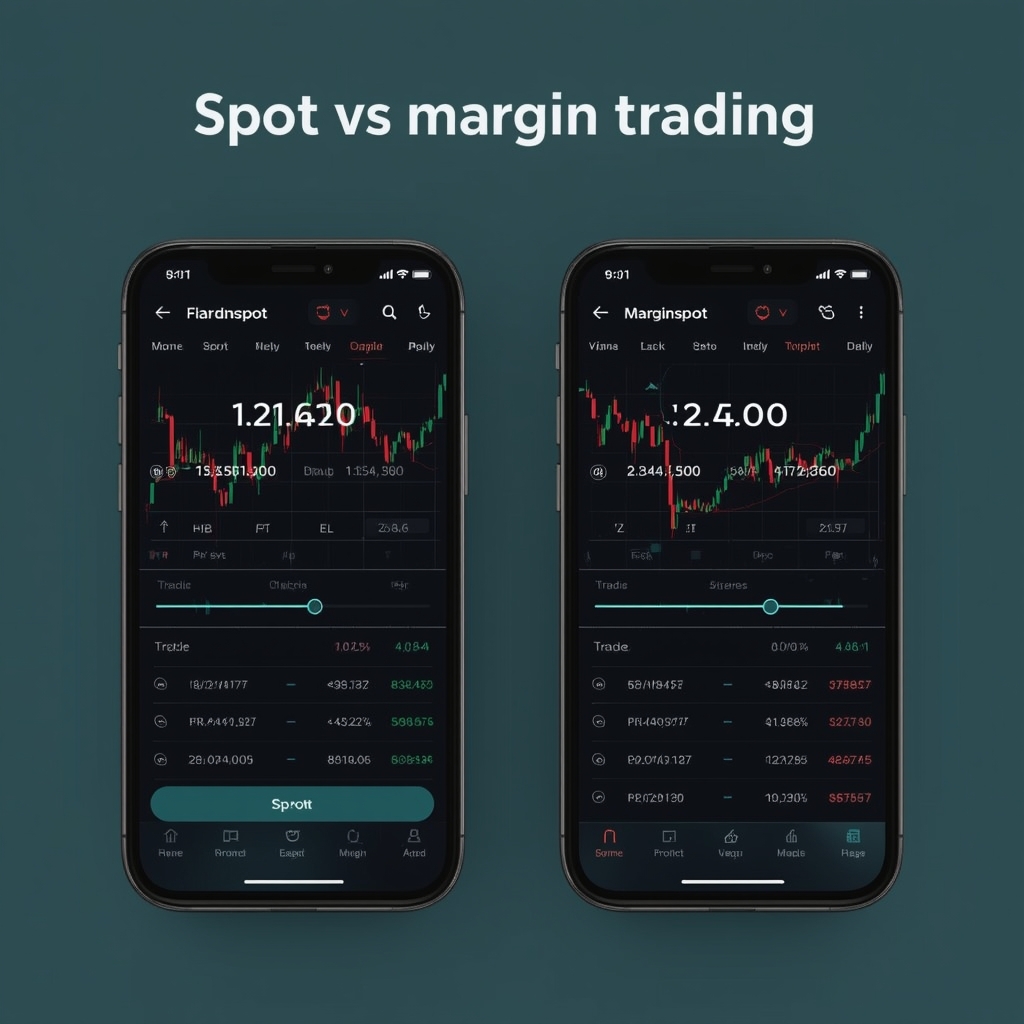
At its essence, spot trading equals ownership; margin trading equals leveraged exposure. Spot is low complexity and lower risk relative to margin when considered per-dollar invested. Margin introduces borrowing costs, liquidation risk, and the psychological pressure of amplified moves. Both have places in a trader’s toolbox — the key is knowing trade size, timeframe, and risk tolerance before choosing between them.
| Feature | Spot Trading | Margin Trading |
|---|---|---|
| Ownership | Own underlying asset | Borrowed exposure, partial collateral |
| Leverage | None | Yes, variable (e.g., 2x–100x) |
| Risk | Market risk only | Market + liquidation + funding risks |
| Best for | Long-term holders, buy-and-hold | Active traders, shorting, hedging |
How leverage works in margin trading
Leverage multiplies exposure by borrowing. If you have $1,000 and use 5x leverage, you control $5,000 worth of crypto; $4,000 is borrowed. Profit and loss are calculated on the full $5,000. If the asset rises 10%, your position increases by $500, and after repaying the loan your return exceeds what you'd get without leverage. Conversely, a 10% drop would cost $500, representing a 50% loss of your original $1,000 capital.
Exchanges set initial and maintenance margin ratios. Initial margin is the collateral required to open a position; maintenance margin is the minimum collateral to keep it open. If the account equity slips below maintenance margin, a margin call or automatic liquidation may occur. Understanding these thresholds is critical to avoid forced exits at unfavorable prices.
Risks and rewards compared
Spot trading’s reward profile is straightforward: you profit if the asset appreciates and lose if it depreciates. Margin’s rewards are amplified — but so are losses. Margin also introduces specific risks: funding fees (in perpetual futures), liquidation risk, counterparty risk if lending comes from exchanges or other traders, and increased volatility sensitivity. Emotional risk is higher too; leveraged positions can provoke rapid, irrational decisions under pressure.
- Advantages of spot trading: ownership, simpler accounting, fewer fees (usually), no liquidation risk.
- Advantages of margin trading: amplified returns, ability to short, capital efficiency for active traders.
| Risk | Spot | Margin |
|---|---|---|
| Liquidation | None | High |
| Borrowing cost | None | Interest/funding fees |
| Volatility sensitivity | Lower | Higher |
Fees and costs: spot vs margin trading
Cost structure differs markedly. Spot traders typically pay taker/maker fees and withdrawal fees. Margin traders pay those plus borrowing interest or funding rates, and sometimes higher trading fees depending on position type. Funding rates on perpetual futures can be positive or negative and may compound over time, meaning long-term leveraged positions can become costly even if market direction is favorable.
Example fee breakdown:
- Spot: trading fee 0.1% per trade; withdrawal $10; no funding.
- Margin: trading fee 0.075% + borrowing interest 0.02%/day; funding adjustments.
When to use spot vs margin trading
Choose spot trading when your thesis centers on long-term asset ownership, staking, or portfolio simplicity. Spot suits investors looking to avoid daily monitoring and those who want to hold through volatility without liquidation risk. Choose margin trading if you have a tactical, short-term view, want to hedge an existing spot position, or need to amplify returns with strict risk controls and capital allocated specifically for high-risk trades.
Practical strategies for spot and margin
Spot strategies include dollar-cost averaging (DCA), portfolio rebalancing, buy-the-dip orders, and long-term HODLing with occasional profit-taking. Margin strategies are often shorter-term: trend-following with tight stop-losses, swing trading around support/resistance, and market-neutral hedges where you pair a leveraged short with a spot long to reduce directional risk.
Example strategies:
- Spot: Monthly DCA into BTC to reduce timing risk.
- Margin: Short-term swing trades with 3x leverage and pre-defined stop-loss levels to limit downside.
Risk management and best practices
Risk management is the differentiator between traders who survive and those who don’t. For spot, focus on position sizing, diversification, and secure custody. For margin, add strict stop-losses, use smaller leverage, and never risk more than a predetermined percentage of your portfolio on any single margin position. Monitor funding rates and set alerts for margin call thresholds. Maintain an emergency buffer in stablecoins or fiat to top up collateral if required.
Key rules to follow:
- Define risk per trade (e.g., 1–2% of capital).
- Use stop-losses and test them in paper trading first.
- Understand exchange-specific liquidation mechanics and fees.
Tools, platforms, and final checklist
Not all exchanges are equal. Spot platforms excel at liquidity and custody options; margin platforms vary widely in available leverage, margin maintenance rules, and borrowing sources. Evaluate exchanges for security history, insurance funds, fee transparency, and user interface. Consider decentralized margin protocols if you prefer permissionless lending, but weigh smart-contract risk and liquidity limitations.
Quick platform checklist:
- Security credentials and audits
- Transparent fee and funding schedules
- Clear liquidation rules and insurance funds
- Available leverage and supported pairs
- Customer support and educational resources
Comparison table: sample platform features
| Platform | Spot fees | Max leverage | Insurance fund |
|---|---|---|---|
| Exchange A | 0.1% | 5x | Yes |
| Exchange B | 0.06% | 100x | No |
| DEX C | 0.2% | Variable via lending pools | N/A |
Glossary and quick FAQs
Margin call: a demand to add funds or reduce positions when collateral drops below maintenance margin. Liquidation: forced closure of positions to repay borrowed funds. Funding rate: periodic payments between traders in perpetual contracts to tether contract price to spot price. Maker/taker fees: maker fees incentivize adding liquidity; taker fees apply when removing liquidity.
Short FAQs:
- Can you convert margin to spot? Yes — once positions are closed and collateral released you can withdraw or convert holdings.
- Is margin trading gambling? It can be without risk controls; skilled traders treat it as disciplined risk-managed speculation.
FAQ
What is spot trading?
Spot trading is buying or selling an asset for immediate delivery and settlement at the current market price, known as the spot price. In crypto, that means you own the coins in your wallet after the trade, with no borrowed capital involved.
What is margin trading?
Margin trading lets you borrow funds from an exchange or other traders to increase your position size, enabling leveraged exposure to price moves. It amplifies potential gains and losses because you trade with more capital than you hold.
How does leverage work in margin trading?
Leverage is a multiplier that lets you control a larger position with a smaller amount of capital (the margin). For example, 5x leverage means a $1,000 deposit controls a $5,000 position; profits and losses are magnified proportionally.
What is a margin call and liquidation?
A margin call occurs when your account equity falls below the required maintenance margin, prompting you to add funds or reduce positions. If you fail to meet requirements, the exchange may forcibly liquidate positions to repay borrowed funds.
What collateral is used in margin trading?
Collateral can be crypto assets or stablecoins deposited in your margin account to secure borrowed funds. The type and acceptable amount vary by exchange and determine how much you can borrow.
Are fees different between spot and margin trading?
Yes. Spot trading typically charges standard trading fees (maker/taker), while margin trading adds borrowing interest or funding rates on top of trading fees, which increases overall costs for leveraged positions.
Which is riskier: spot or margin trading?
Margin trading is riskier due to leverage, borrowing costs, and the threat of liquidation; losses can exceed initial capital if not managed. Spot trading carries market risk but does not introduce borrowed capital or margin calls.
Can spot trading be used for short-term strategies?
Yes, spot trading is commonly used for day trading, swing trading, and long-term buys. While you can’t short via spot alone, you can sell an asset you already hold or use derivatives for short exposure.
Can you short cryptocurrencies using margin trading?
Yes. Margin trading often allows short positions by borrowing an asset and selling it, with the aim to buy it back cheaper later. This enables traders to profit from price declines.
How do funding rates affect margin traders?
Funding rates are periodic payments between long and short positions on some margin/derivative platforms to keep contract prices aligned with spot markets. Paying or receiving funding can affect profitability for leveraged positions.
What are common strategies for spot traders?
Common spot strategies include buy-and-hold (HODL), dollar-cost averaging (DCA), swing trading, and arbitrage across exchanges. These focus on owning actual assets and managing risk without leverage.
What risk management tools should margin traders use?
Margin traders should use stop-loss orders, position sizing rules, diversification, and maintain healthy collateral buffers to limit liquidation risk and control downside. Monitoring funding rates and borrowing costs is also critical.
How does liquidity matter for spot vs margin trading?
High liquidity benefits both: for spot it reduces slippage when executing orders; for margin it also ensures positions can be opened/closed without wide spreads, which is essential under leverage. Low liquidity increases execution risk and potential losses.
Do taxes differ between spot and margin trading?
Tax rules vary by jurisdiction, but both spot and margin trades can generate taxable events. Margin trading may involve additional complexities like interest deductions, realized gains/losses on borrowed asset sales, and separate reporting for short positions.
What platforms support margin trading?
Many centralized crypto exchanges (Binance, Kraken, Bitfinex, Bybit) and some decentralized platforms offer margin or leverage trading. Each platform differs in available leverage, collateral options, fees, and liquidation rules.
How does emotional discipline differ between spot and margin trading?
Margin trading often demands stricter emotional control because leveraged losses accumulate quickly and margin calls can force action under stress. Spot trading is generally less psychologically intense but still requires discipline for timing and risk management.
Can beginners start with margin trading?
Beginners should be cautious; margin trading significantly increases complexity and risk. It's advisable to master spot trading, risk management, and market behavior before using leverage, and to start with low leverage if attempting margin.
How do security considerations compare between spot and margin accounts?
Both require strong security practices (2FA, cold storage for long-term holdings), but margin accounts may expose more risk since borrowed positions and cross-margin modes can put broader balances at risk. Understand platform security and custody terms.
What happens to ownership when you use margin to buy an asset?
When you use margin to buy an asset, you typically control the asset but it serves as collateral for the loan; ownership may be restricted by the platform until the loan is repaid. In some cases, exchanges can liquidate collateral to cover debt.
How does capital efficiency differ between spot and margin trading?
Margin trading improves capital efficiency by allowing traders to deploy less capital to achieve larger exposure via leverage. Spot requires full capital upfront to obtain the same exposure, making margin more capital-efficient but riskier.
How do funding costs compare?
Spot trading has no funding costs beyond trading fees. Margin trading incurs borrowing interest or periodic funding fees, which accumulate over time and can erode returns on long-duration leveraged positions.
How does leverage affect profit and loss potential?
Leverage multiplies both profits and losses. A 10% move in the underlying asset yields a 10% gain on spot, but with 5x leverage it becomes a 50% gain — and likewise a 50% loss if the price moves against you.
How does margin trading impact long-term investing?
Margin trading is generally unsuitable for long-term investing due to ongoing interest/funding costs and liquidation risk during volatile periods. Long-term investors typically prefer spot ownership to avoid recurring charges and forced exits.
Are liquidation rules the same across exchanges?
No. Liquidation thresholds, maintenance margin requirements, and liquidation mechanisms vary by exchange and product. Traders must read platform-specific rules to understand when positions may be forcibly closed.
How does slippage differ between spot and margin orders?
Slippage depends on market liquidity and order type; margin trading can amplify the impact of slippage since bigger effective position sizes increase the order's market impact. Using limit orders and trading in liquid markets reduces slippage.
Can you hedge spot positions with margin instruments?
Yes. Traders often hedge spot holdings by opening short margin or derivatives positions to offset downside risk. This can protect a portfolio without selling long-term holdings, though hedging introduces borrowing costs and complexity.
How do fees and costs compare for identical positions on spot vs margin?
For the same directional exposure, spot requires full capital and only trading fees, while margin adds borrowing interest/funding fees and potentially higher margin trading fees, making margin generally more expensive over time.
How do maintenance margin and margin requirements compare to owning spot outright?
Owning spot outright has no maintenance margin; you hold the asset until you choose to sell. Margin positions require maintaining a minimum equity level; falling below it triggers margin calls or liquidation, adding ongoing upkeep.
How does leverage affect tax reporting compared to spot?
Tax treatment depends on jurisdiction, but leveraged trades can complicate reporting because you may have taxable events from borrowing, interest deductibility, and profits/losses from short positions, whereas spot trading has simpler buy/sell tax events.
Which is better for beginners: spot or margin?
Spot is typically better for beginners because it’s simpler, less risky, and educates traders on market mechanics without leverage-related stress. Margin should be approached only after gaining experience and a solid risk-management plan.
How do market crashes affect spot vs margin positions?
In crashes, spot positions fall in value but remain held (unless sold), while margin positions risk rapid liquidation due to leverage, potentially resulting in forced exits and amplified losses. Margin users can lose more than their initial capital in extreme cases.